What Is the Industry Term Used to Describe the Sum of Prices Paid by a Businessã¢â‚¬â„¢s Customers?

A price tag is a highly visual and objective guide to value
Pricing is the process whereby a business sets the price at which information technology will sell its products and services, and may be part of the business's marketing plan. In setting prices, the business will have into account the toll at which it could larn the appurtenances, the manufacturing price, the marketplace, competition, market condition, brand, and quality of product.
Pricing is a fundamental attribute of production management and is one of the four Ps of the marketing mix, the other three aspects beingness product, promotion, and place. Price is the just revenue generating element amongst the four Ps, the rest beingness cost centers. However, the other Ps of marketing will contribute to decreasing cost elasticity and so enable cost increases to drive greater acquirement and profits.
Pricing tin can be a transmission or automatic process of applying prices to purchase and sales orders, based on factors such as: a fixed amount, quantity break, promotion or sales campaign, specific vendor quote, cost prevailing on entry, shipment or invoice engagement, combination of multiple orders or lines, and many others. An automated pricing system requires more than setup and maintenance only may forestall pricing errors. The needs of the consumer can be converted into demand only if the consumer has the willingness and capacity to buy the product. Thus, pricing is the most important concept in the field of marketing, information technology is used every bit a tactical determination in response to changing competitive, market and organizational situations.
Objectives of pricing [edit]
The objectives of pricing should consider:
- the financial goals of the company (i.east. profitability)
- the fit with marketplace realities (will customers buy at that price?)
- the extent to which the cost supports a product's market positioning and be consequent with the other variables in the marketing mix
- the consistency of prices across categories and products (consistency indicates reliability and supports client confidence and customer satisfaction)
- To encounter or prevent competition
Toll is influenced past the type of distribution channel used, the type of promotions used, and the quality of the production. Where manufacturing is expensive, distribution is exclusive, and the product is supported by extensive advertizing and promotional campaigns, then prices are likely to exist higher. Cost can deed equally a substitute for production quality, effective promotions, or an energetic selling effort by distributors in certain markets.
From the marketer's bespeak of view, an efficient toll is a cost that is very close to the maximum that customers are prepared to pay. In economic terms, it is a price that shifts most of the consumer economical surplus to the producer. A skillful pricing strategy would be the i that could balance betwixt the price floor (the toll below which the organization ends up in losses) and the price ceiling (the toll past which the organization experiences a no-demand situation).
Pricing strategies [edit]
Marketers develop an overall pricing strategy that is consistent with the system's mission and values. This pricing strategy typically becomes part of the company's overall long-term strategic plan. The strategy is designed to provide broad guidance for price-setters and ensures that the pricing strategy is consequent with other elements of the marketing plan. While the bodily toll of appurtenances or services may vary in response to dissimilar conditions, the broad approach to pricing (i.e., the pricing strategy) remains a abiding for the planning outlook period which is typically 3–v years, simply in some industries may exist a longer menses of 7–10 years. The pricing strategy established the overall, long-term goals of the pricing function, without specifying an bodily cost-point.[ane]
Broadly, in that location are half dozen approaches to pricing strategy mentioned in the marketing literature:
- Operations-oriented pricing: where the objective is to optimize productive capacity, to achieve operational efficiencies or to friction match supply and demand through varying prices. In some cases, prices might be prepare to de-market.[2]
- Acquirement-oriented pricing: (also known as turn a profit-oriented pricing or cost-based pricing) - where the marketer seeks to maximize the profits (i.e., the surplus income over costs) or simply to embrace costs and suspension even.[2] For example, dynamic pricing (also known as yield management) is a class of revenue oriented pricing.
- Customer-oriented pricing: where the objective is to maximize the number of customers; encourage cross-selling opportunities or to recognize different levels in the customer'due south ability to pay.[2]
- Value-based pricing: (also known as prototype-based pricing) occurs where the company uses prices to signal market place value or associates price with the desired value position in the heed of the buyer. The aim of value-based pricing is to reinforce the overall positioning strategy eastward.g. premium pricing posture to pursue or maintain a luxury image.[3] [4]
- Relationship-oriented pricing: where the marketer sets prices in gild to build or maintain relationships with existing or potential customers.[5]
- Socially-oriented pricing: Where the objective is to encourage or discourage specific social attitudes and behaviours. east.grand. high tariffs on tobacco to discourage smoking.[6]
- Optional pricing: Where the objective is to allow consumer to have an option on their purchase. e.thou. buying a car optional to accept CD player [7]
Pricing tactics [edit]
When conclusion-makers have determined the wide approach to pricing (i.due east., the pricing strategy), they turn their attending to pricing tactics. Tactical pricing decisions are shorter term prices, designed to accomplish specific brusk-term goals. The tactical approach to pricing may vary from time to fourth dimension, depending on a range of internal considerations (e.g. such equally the demand to clear surplus inventory) or external factors (e.g. a response to competitive pricing tactics). Accordingly, a number of different pricing tactics may be employed in the course of a single planning period or across a single yr. Typically line managers are given the latitude necessary to vary individual prices providing that they operate within the broad strategic approach. For example, some premium brands never offer discounts considering the use of low prices may tarnish the brand epitome. Instead of discounting, premium brands are more than likely to offer customer value through toll-bundling or giveaways.
When setting individual prices, determination-makers crave a solid understanding of pricing economic science, notably intermission-even analysis,[8] every bit well equally an appreciation of the psychological aspects of consumer conclusion-making including reservation prices, ceiling prices and floor prices. The marketing literature identifies literally hundreds of pricing tactics.[9] It is difficult to do justice to the variety of tactics in widespread apply. Rao and Kartono carried out a cross-cultural study to identify the pricing strategies and tactics that are virtually widely used.[x] The following listing is largely based on their work.
ARC/RRC pricing [edit]
A traditional tactic used in outsourcing that uses a stock-still fee for a stock-still volume of services, with variations on fees for volumes above or below target thresholds. Charges for additional resources ("ARCs") above the threshold are priced at rates to reflect the marginal cost of the boosted production plus a reasonable profit. Credits ("RRCs") granted for reduction in resource consumed or provided offer the enterprise client some comfort, only the savings on credits tend not to be equivalent to the increased costs when paying for incremental resources in excess of the threshold.[11]
Complementary pricing [edit]

The purchase of a printer leads to a lifetime of purchases of replacement parts. In such cases, complementary pricing may exist considered.
Complementary pricing is an umbrella category of "captive-marketplace" pricing tactics. It refers to a method in which one of two or more complementary products (a deskjet printer, for example) is priced to maximize sales volume, while the complementary product (printer ink cartridges) are priced at a much college level in order to comprehend whatsoever shortfall sustained past the get-go product.[12]
Contingency pricing [edit]
Contingency pricing is the procedure where a fee is merely charged contingent on certain results. Contingency pricing is widely used in professional services such as legal services and consultancy services.[xiii] In the Great britain, a contingency fee is known every bit a provisional fee.[14]
Differential pricing [edit]
Differential pricing, too known every bit flexible pricing, multiple pricing or price bigotry , occurs where unlike prices are charged to different customers or marketplace-segments, and may be dependent on the service provider's assessment of the customer's willingness or ability to pay.[15] There are diverse forms of price difference including: the type of customer, the geographic area served, the quantity ordered, commitment time, payment terms, etc.
Discrete pricing [edit]
Detached Pricing occurs when prices are fix at a level that the price comes inside the competence of the decision making unit (DMU).[16] This method of pricing is often used in B2B contexts where the purchasing officeholder may be authorized to make purchases up to a predetermined level, across which decisions must go to a committee for authorization. With the advent of information analytics differential price is becoming pop with most companies using customer specific data to give prices to specific customer.
Discount pricing [edit]
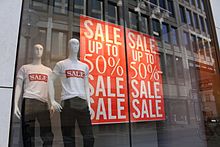
A discount is any grade of reduction in toll
Disbelieve pricing is where the marketer or retailer offers a reduced cost. Discounts in a multifariousness of forms - eastward.g. quantity rebates, loyalty rebates, seasonal discounts, periodic or random discounts etc.[17] Enormous retailers can request value limits from providers and make a rebate evaluating system powerful as they buy in mass. Information technology is normally difficult to rival these retailers dependent on a rebate estimating technique. This type of pricing strategy is a predominant showcasing procedure to describe in shoppers by providing an additional worth or motivator, which urges customers to purchase the advanced items right away.[18]
Diversionary pricing [edit]
Diversionary Pricing is a variation of loss leading used extensively in services; a depression cost is charged on a basic service with the intention of recouping on the extras; can also refer to low prices on some parts of the service to develop an image of low price.
Everyday depression prices [edit]

"Everyday Depression Prices" are widely used in supermarkets
Everyday low prices refers to the practice of maintaining a regular low price - in which consumers are non forced to await for discounting or specials. This method is used past supermarkets.[19]
Go out fees [edit]
Leave fees are fees charged to customers who depart from the service process prior to natural completion or the end of a contract.[20] The objective of an get out fee is to deter premature exit.[21] Exit fees are frequently plant in financial services, telecommunications services and anile care facilities. Regulatory authorities, effectually the globe, have oftentimes expressed their discontent with the practice of leave fees as it has the potential to be anti-competitive and restricts consumers' abilities to switch freely, just the practice has not been proscribed.[22]
Feel curve pricing [edit]
Experience bend pricing occurs when a manufacturer prices a production or service at a low rate in order to obtain volume and with the expectation that the cost of production will subtract with the conquering of manufacturing experience. This arroyo which is oft used in the pricing of high technology products and services, is based on the insight that manufacturers learn to trim production costs over time in a miracle known as experience effects.[17]
Geographic pricing [edit]
Geographic pricing occurs when dissimilar prices are charged in different geographic markets for an identical product.[17] For example, publishers often make text-books available at lower prices in Asian countries considering average wages tend to be lower with implications for the client's ability to pay. In other cases, geographic variations in prices may reflect the unlike costs of distribution and servicing certain markets.[23]
Guaranteed pricing [edit]
Guaranteed pricing is a variant of contingency pricing. Information technology refers to the practice of including an undertaking or promise that certain results or outcomes will be achieved. For instance, some business organization consultants undertake to improve productivity or profitability by 10%. In the event that the result is not achieved, the customer does not pay for the service.[24]
High-low pricing [edit]
High-low pricing refers to the practise of offering goods at a high price for a period of time, followed by offering the same goods at a depression price for a predetermined time. This exercise is widely used past chain stores selling homewares. The main disadvantage of the high-depression tactic is that consumers tend to become aware of the price cycles and time their purchases to coincide with a low-toll cycle.[25] [26]
Honeymoon pricing [edit]
Honeymoon Pricing refers to the practice of using a depression introductory price with subsequent price increases one time relationship is established. The objective of honeymoon pricing is to "lock" customers into a long-term association with the vendor. This approach is widely used in situations where client switching costs are relatively loftier such as in home loans and fiscal investments.[27] It is besides mutual in categories where a subscription model is used, especially if this is coupled with automatic regular payments, such as in paper and magazine subscriptions, cable TV, broadband and jail cell phone subscriptions and in utilities and insurance.
Loss leader [edit]
A loss leader is a product that has a price ready below the operating margin. Loss leading is widely used in supermarkets and budget-priced retail outlets where the store as a means of generating shop traffic. The depression cost is widely promoted and the store is prepared to take a minor loss on an individual item, with an expectation that it will recoup that loss when customers buy other college priced-higher margin items. In service industries, loss leading may refer to the practice of charging a reduced toll on the first lodge as an inducement and with apprehension of charging higher prices on subsequent orders. Loss leading is ofttimes found in retail, where the loss leader is used to drive shop traffic and generate sales of complementary items.[28]
Offset pricing [edit]
Offset pricing (also known as diversionary pricing) is the service industry'due south equivalent of loss leading. A service may cost 1 component of the offer at a very low price with an expectation that information technology tin can compensate whatever losses by cross-selling additional services. For case, a rug steam cleaning service may charge a very low basic cost for the first three rooms, only charges college prices for additional rooms, furniture and curtain cleaning. The operator may also try to cross-sell the customer on additional services such as spot-cleaning products, or stain-resistant treatments for fabrics and carpets.[xiii]
Parity pricing [edit]
Parity pricing refers to the process of pricing a product at or near a rival'south price in order to remain competitive.[29] Markets can be sectioned empowering the business firm to segregate between the fare and homegrown market it is indicated that the defectively serious firm can differentially toll. Too, as the quantity of homegrown firms is expanded, and if these organizations can portion the marketplace, the differential among homegrown and unfamiliar costs is diminished. The import equality cost might be charged in the homegrown market.[30]
Price bundling [edit]
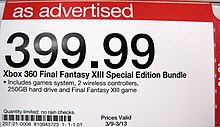
Price bundling (also known every bit product bundling) occurs where two or more than products or services are priced as a package with a unmarried price. There are several types of bundles: pure bundles where the goods can merely be purchased as parcel or mixed bundles where the goods tin can be purchased individually or equally a packet. The prices of the package is typically less than when the ii items are purchased separately.[31]
Peak and off-peak pricing [edit]
Peak and off-peak pricing is a form of price discrimination where the price variation is due to some type of seasonal factor. The objective of elevation and off peak pricing is to use prices to even out peaks and troughs in demand. Peak and off-peak pricing is widely used in tourism, travel and besides in utilities such every bit electricity providers. Top pricing has caught the public'south imagination since the ride-sharing service provider, Uber, commenced using surge pricing and has sought to patent the technologies that support this approach.[32]
Price discrimination [edit]
Cost discrimination is as well known as variable pricing or differential pricing.
Price lining [edit]
Cost lining is the use of a limited number of prices for all production offered by a business organisation. Price lining is a tradition started in the old 5 and dime stores in which everything cost either 5 or 10 cents. In price lining, the price remains abiding simply quality or extent of product or service adjusted to reflect changes in cost. The underlying rationale of this tactic is that these amounts are seen as suitable cost points for a whole range of products by prospective customers. It has the reward of ease of administering, but the disadvantage of inflexibility, particularly in times of inflation or unstable prices. Price lining continues to be widely used in department stores where customers often annotation racks of garments or accessories priced at predetermined price points e.grand. split racks of men's ties, where each rack is priced at $10, $20 and $twoscore.
Penetration pricing [edit]
Penetration pricing is an approach that tin be considered at the time of market entry. In this approach, the toll of a production is initially gear up low in an effort to penetrate the market place quickly. Depression prices and low margins also act equally a deterrent, preventing potential rivals from entering the market place since they would accept to undercut the depression margins to proceeds a foothold.[33]
Prestige pricing [edit]

Premium brands rarely discount due to the potential to tarnish the brand. Instead they offering gift packs to provide customers with value
Prestige pricing is also known as premium pricing and occasionally luxury pricing or high price maintenance refers to the deliberate pursuit of a loftier price posture to create an epitome of quality.[34]
Price signaling [edit]
Toll signaling is where the cost is used as an indicator of another attribute. For example, some travel resorts promote that when two adults make a booking, the kids stay for costless. This type of pricing is designed to betoken that the resort is a family unit friendly operation.[35]
Price skimming [edit]
Toll skimming, also known as skim-the-cream pricing is a tactic that might be considered at market entry. The objective is to charge relatively high prices in lodge to recoup the cost of product development early in the life-bike and before competitors enter the market.[33]
Promotional pricing [edit]
Promotional pricing is a temporary measure that involves setting prices at levels lower than normally charged for a practiced or service. Promotional pricing is sometimes a reaction to unforeseen circumstances, as when a downturn in demand leaves a visitor with excess stocks; or when competitive activeness is making inroads into market share or profits.[36]
Two-part pricing [edit]
2-part pricing is a variant of convict-market pricing used in service industries. Two-part pricing breaks the actual cost into ii parts; a fixed service fee plus a variable consumption charge per unit. Two-part pricing tactics are widely used past utility companies such as electricity, gas and h2o and services where there is a quasi- membership type relationship, credit cards where an almanac fee is charged and theme parks where an archway fee is charged for access while the customer pays for rides and extras. 1 part of the price represents a membership fee or joining fee, while the 2nd function represents the usage component.[37]
Psychological pricing [edit]
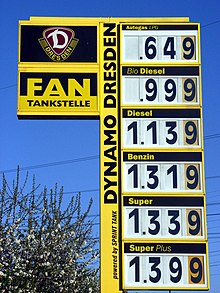
Extensive employ of the terminal digit '9' suggests that psychological pricing is at play
Psychological pricing is a range of tactics designed to accept a positive psychological impact. Price tags using the final digit "ix", ($9.99, $19.99 or $199.99) can be used to signal price points and bring an particular in at just under the consumer's reservation price. Psychological pricing is widely used in a diversity of retail settings.[38]
Premium pricing [edit]
Premium pricing (also called prestige pricing[39]) is the strategy of consistently pricing at, or near, the loftier end of the possible price range to help concenter status-conscious consumers. The high pricing of a premium product is used to enhance and reinforce a product'south luxury epitome. Examples of companies that partake in premium pricing in the marketplace include Rolex and Bentley. As well as brand, product attributes such as eco-labelling and provenance (e.g. 'certified organic' and 'product of Australia') may add value for consumers[40] and attract premium pricing. A component of such premiums may reverberate the increased cost of production. People volition buy a premium priced product because:
- They believe the high price is an indication of good quality
- They believe information technology to be a sign of self-worth - "They are worth it;" it authenticates the buyer'southward success and condition; information technology is a signal to others that the possessor is a member of an exclusive group
- They crave flawless functioning in this application - The cost of product malfunction is too high to purchase anything only the best - for instance, a heart pacemaker.
The sometime association of luxury just being for the kings and queens of the earth is almost non-existent in today'due south world. People accept by and large go wealthier, therefore the mass marketing miracle of luxury has simply become a part of everyday life, and no longer reserved for the elite.[41] Since consumers accept a larger source of disposable income, they now have the power to purchase products that meet their aspirational needs. This phenomenon enables premium pricing opportunities for marketers in luxury markets.[42] Luxurification in club can exist seen when middle form members of social club, are willing to pay premium prices for a service or product of the highest quality when compared with like appurtenances. Examples of this tin can be seen with items such as article of clothing and electronics. Charging a premium price for a product as well makes it more inaccessible and helps information technology gain an exclusive appeal. Luxury brands such as Louis Vuitton and Gucci are more than only wearable and become more of a status symbol. (Yeoman, 2011).
Prestige goods are usually sold by companies that have a monopoly on the market place and concur competitive reward. Due to a firm having great market power they are able to charge at a premium for goods, and are able to spend a larger sum on promotion and ad.[43] According to Han, Nunes and Dreze (2015) figure on "signal preference and taxonomy based on wealth and need for status" 2 social groups known as "Parvenus" and "Poseurs" are individuals mostly more self-conscious, and base purchases on a need to attain a higher status or gain a social prestige value.[44] Further market research shows the role of possessions in consumer's lives and how people brand assumptions nigh others solely based on their possessions. People associate high priced items with success. (Han et al., 2010). Marketers understand this concept, and price items at a premium to create the illusion of exclusivity and loftier quality. Consumers are likely to purchase a product at a higher price than a like product equally they require the status, and feeling of superiority equally being part of a minority that tin can in fact afford the said product. (Han et al., 2010).
A cost premium can likewise be charged to consumers when purchasing eco-labelled products. Market based incentives are given in club to encourage people to practice their business in an eco-friendly mode in regard to the environment.[45] Associations such every bit the MSC's fishery certification program and seafood ecolabel reward those who practice sustainable fishing. Pressure level from environmental groups have acquired the implementation of Associations such as these, rather than consumers demanding information technology. The value consumer'southward gain from purchasing environmentally witting products may create a premium price over non eco-labelled products. This means that producers have some sort of incentive for supplying goods worthy of eco-labelling standard. Usually more costs are incurred when practicing sustainable business, and charging at a premium is a way businesses tin can recover actress costs.[46]
Methods of setting prices [edit]
Demand-based pricing [edit]
Demand-based pricing, also known as dynamic pricing, is a pricing method that uses consumer demand - based on perceived value - as the central element. These include price skimming, price discrimination and yield management, price points, psychological pricing, bundle pricing, penetration pricing, price lining, value-based pricing, geo and premium pricing.
Pricing factors are manufacturing cost, market place, contest, market condition, quality of product.
Price modeling using econometric techniques tin help measure price elasticity, and computer based modeling tools will often facilitate simulations of unlike prices and the effect on sales and profit. More sophisticated tools help determine price at the SKU level across a portfolio of products. Retailers will optimize the price of their individual label SKUs with those of National Brands.
Uber's pricing policy is an example of demand-based dynamic pricing. Information technology uses an automated algorithm to increase prices to "surge price" levels, responding quickly to changes of supply and demand in the market. Past responding in real-time, an equilibrium between demand and supply of drivers tin be approached.[47] [48] Customers receive notice when making an Uber reservation that prices accept increased.[47] The visitor applied for a U.Southward. patent on surge pricing in 2013, though airlines are known to have been using similar techniques in seat pricing for years.[49] [fifty]
The practice has often caused passengers to get upset and invited criticism when it happens equally a result of holidays, inclement conditions, natural disasters or other factors.[51] During New Year's Eve 2011, Uber prices were as high every bit seven times normal rates, causing outrage.[52] During the 2014 Sydney earnest crunch, Uber implemented surge pricing, resulting in fares of up to iv times normal charges; while it dedicated the surge pricing at first, it later apologized and refunded the surcharges.[53] Uber CEO Travis Kalanick has responded to criticism by proverb: "...because this is so new, it's going to have some time for folks to have information technology. In that location's 70 years of conditioning around the fixed toll of taxis."[52] [54]
Multidimensional pricing [edit]
Multidimensional pricing is the pricing of a product or service using multiple numbers. In this practice, price no longer consists of a single monetary amount (e.g., sticker price of a auto), but rather consists of various dimensions (due east.g., monthly payments, number of payments, and a downpayment). Enquiry has shown that this do tin can significantly influence consumers' ability to sympathize and procedure toll information.[55]
Micromarketing [edit]
Micromarketing is the practice of tailoring products, brands (microbrands), and promotions to meet the needs and wants of microsegments inside a market. Information technology is a blazon of market place customization that deals with pricing of customer/product combinations at the store or private level.
Theoretical considerations in pricing [edit]
Price/quality relationship [edit]
The price/quality relationship comprises consumers' perceptions of value. High prices are frequently taken as a sign of quality, especially when the product or service lacks search qualities that can be inspected prior to purchase.[57] Agreement consumers' perceptions of the price/quality relationship is well-nigh important in the case of complex products that are hard to test, and experiential products that cannot be tested until used (such as nigh services). The greater the doubt surrounding a production, the more than consumers depend on the cost/quality betoken and the greater premium they may exist prepared to pay.
Consumers tin can have different perceptions on premium pricing, and this gene makes information technology important for the marketer to understand consumer behaviour. Co-ordinate to Vigneron and Johnson'southward figure on "Prestige-Seeking Consumer Behaviours", Consumers can be categorized into four groups. These groups being; Hedonist & Perfectionist, snob, bandwagon and veblenian.[58] These categories rank from level of self-consciousness, to importance of price as an indicator of prestige. The Veblen Effect explains how this group of consumers makes purchase decisions based on conspicuous value, as they tend to purchase publicly consumed luxury products. This shows they are likely to make the purchase to show power, status and wealth.[59] Consumers that autumn under the "Snob Effect" can be described as individuals that search for perceived unique value, and will buy exclusive products in order to be the first or very few who has it. They will also avoid purchasing products consumed by a general mass of people, equally it is perceived that items in limited supply agree a higher value than items that exercise non. (Vigneron & Johnson, 1999). The bandwagon result explains that consumers that fit into this category make purchasing decisions to fit into a social group, and proceeds a perceived social value out of purchasing popular products within said social group at premium prices. Inquiry shows that people will often conform to what the bulk of the group they are a member of thinks when information technology comes to the mental attitude of a product. Paying a premium price for a product can human action as a way of gaining credence, due to the pressure placed on them by their peers. The Hedonic effect tin be described as a certain group of people whose purchasing decisions are not affected by the condition and exclusivity gained by purchasing a product at a premium, nor susceptible to the fear of being left out and peer pressure. Consumers who fit into this category base their purchasing decisions on a perceived emotional value, and proceeds intangible benefits such every bit sensory pleasance, artful beauty and excitement. Consumers of this type have a higher interest on their own wellbeing. (Vigneron & Johnson, 1999). The last category on Vigneron and Johnson's figure of "Prestige-Seeking Consumer Behaviours" is the perfectionism issue. Prestige brands are expected to testify high quality, and information technology'southward this reassurance of the highest quality that can really enhance the value of the product. According to this effect, those that fit into this group value the prestige'due south brands to have a superior quality and higher operation than other similar brands. Enquiry has indicated that consumer's perceive quality of a product to exist relational to its price. Consumers often believe a high price of a production indicates a higher level of quality.
Even though it is suggested that high prices seem to make sure products more desirable, consumers that fall in this category accept their own perception of quality and make decisions based upon their own judgement.[58] [60] They may also utilise the premium price as an indicator of the product'southward level of quality.
Price sensitivity and consumer psychology [edit]
In their book, The Strategy and Tactics of Pricing, Thomas Nagle and Reed Holden outline nine laws or factors that influence how a consumer perceives a given price and how cost-sensitive south/he is likely to exist with respect to unlike buy decisions: [61] [62]
- Reference price outcome: Buyer's toll sensitivity for a given product increases the higher the production'southward toll relative to perceived alternatives. Perceived alternatives can vary by buyer segment, by occasion, and other factors.
- Difficult comparison effect Buyers are less sensitive to the toll of a known / more reputable product when they have difficulty comparing it to potential alternatives.
- Switching costs consequence: The higher the production-specific investment a buyer must brand to switch suppliers, the less toll sensitive that buyer is when choosing between alternatives.
- High switching costs: Organizations that produce that have scarcely any substitutes and require huge exertion to ace their utilization capeesh huge exchanging costs. Some firms has additionally fused membership deals, which add greater consistency to its plan of activity and further secure their clients. Similarly every bit with numerous innovation organizations, vulnerability remains in regards to its new detail comeback cycle and reception of new items.
- Low switching costs: Organizations that offering items or administrations that are uncommonly simple to imitate at equivalent costs by contenders regularly take low exchanging costs. For example, clothing company have restricted exchanging costs among customers, who can discover garments bargains finer and can quickly think about costs by strolling starting with one store and then onto the next. The rising of Internet retailers and quick transportation has made it significantly simpler for customers to search for attire at their homes over numerous online stages.
- Cost-quality effect: Buyers are less sensitive to cost the more that higher prices bespeak higher quality. Products for which this outcome is particularly relevant include: image products, exclusive products, and products with minimal cues for quality.
- Expenditure effect: Buyers are more than toll sensitive when the expense accounts for a large percentage of buyers' available income or upkeep.
- End-benefit effect: The effect refers to the relationship a given purchase has to a larger overall benefit, and is divided into two parts:
- Derived demand: The more than sensitive buyers are to the price of the stop benefit, the more than sensitive they will be to the prices of those products that contribute to that do good.
- Price proportion cost: The toll proportion toll refers to the percent of the total price of the end benefit accounted for by a given component that helps to produce the end do good (e.g., recall CPU and PCs). The smaller the given components share of the full cost of the end benefit, the less sensitive buyers volition be to the component'due south price.
- Shared-cost effect: The smaller the portion of the buy cost buyers must pay for themselves, the less toll sensitive they will be.
- Fairness issue: Buyers are more sensitive to the price of a product when the price is outside the range they perceive as "fair" or "reasonable" given the purchase context.
- Framing consequence: Buyers are more price sensitive when they perceive the price as a loss rather than a forgone gain, and they take greater price sensitivity when the price is paid separately rather than every bit function of a bundle.
Approaches [edit]
Pricing is the most effective turn a profit lever.[63] Pricing can be approached at 3 levels: the industry, market, and transaction level.
- Pricing at the industry level focuses on the overall economic science of the industry, including supplier cost changes and customer demand changes.
- Pricing at the market level focuses on the competitive position of the price in comparison to the value differential of the product to that of comparative competing products.
- Pricing at the transaction level focuses on managing the implementation of discounts away from the reference, or list cost, which occur both on and off the invoice or receipt.
A "cost waterfall" analysis helps businesses and sales personnel to understand the differences which arise between the reference or list price, the invoiced auction price and the bodily cost paid by a customer taking account of contract, sales and payment discounts.[64]
Pricing mistakes [edit]
Many companies make mutual pricing mistakes. Jerry Bernstein's article Utilize Suppliers' Pricing Mistakes [65] outlines several sales errors, which include:
- Weak controls on discounting (price override)
- Inadequate systems for tracking competitors' selling prices and market share (Competitive intelligence)
- Cost-plus pricing
- Price increases poorly executed
- Worldwide price inconsistencies
- Paying sales representatives on sales volume vs. improver of revenue measures
Contrary to common misconception, price is not the most important factor for consumers, when deciding to purchase a product.[66]
Meet also [edit]
- Allocation of purchase cost deviation
- Bait pricing
- Base point pricing
- Congestion pricing
- Contribution margin
- Price the limit of cost
- Demand-based pricing
- Distribution
- Drip pricing
- Dumping (pricing policy)
- Factor price
- Free price system
- Group buy
- High-low pricing
- Marketing
- Marketing mix
- Market place partition
- Opportunity price
- Pay what you lot desire
- Toll ceiling
- Price controls
- Cost fixing
- Price fixing cases
- Price gouging
- Price machinery
- Toll premium
- Cost signal
- Price organization
- Cost umbrella
- Pricing scientific discipline
- Pricing strategies
- Promotion
- Purchasing ability
- Existent prices and ideal prices
- Relative toll
- Retail
- Resale price maintenance
- Shadow price
- Sliding scale fees
- Suggested retail price
- Target pricing
- Ticket resale
- Time-based pricing
- Value pricing
- Unit price
References [edit]
- ^ Smith, T., Pricing Strategy: Setting Cost Levels, Managing Cost Discounts and Establishing Cost Structures, Cengage Learning, 2011, pp 270-272
- ^ a b c Dibb, S., Simkin, Fifty., Pride, W.C. and Ferrell, O.C.,Marketing: Concepts and Strategies, Cengage, 2013, Chapter 12
- ^ Nagle, T., Hogan, J. and Zale, J., The Strategy and Tactics of Pricing: A Guide to Growing More Profitably, Oxon, Routledge, 2016, p. 1 and 6
- ^ Brennan, R., Canning,L. and McDowell, R., Business-to-Business concern Marketing, second ed., London, Sage, 2011, p.331
- ^ Neumeier, M., The Brand Flip: Why customers now run companies and how to profit from it (Voices That Thing),2008, p. 55
- ^ Irvin, One thousand., Mod Cost-Do good Methods, Macmillan, 1978, pp 137-160
- ^ Kotler Principle of Marketing, Pearson
- ^ Nagle, T., Hogan, J. and Zale, J., The Strategy and Tactics of Pricing: A Guide to Growing More Profitably, Oxon, Routledge, 2016, pp 207-243
- ^ Tellis, G., "Across the Many Faces of Price: An Integration of Pricing Strategies," Periodical of Marketing, vol. 50, Oct, 1985, p. 158
- ^ Rao, 5.R. and Kartono, B., "Pricing Strategies and Objectives: A Cross-cultural Survey," in Handbook of Pricing Enquiry in Marketing,Rao, V.R. (ed), Northampton, MA, Edward Elgar, 2009, pp 9-36
- ^ Virginia Information Technologies Agency, "Pricing Structure Review" March 2015 "Archived re-create" (PDF). Archived (PDF) from the original on 2017-01-08. Retrieved 2017-02-22 .
{{cite web}}: CS1 maint: archived copy as title (link) - ^ Business Dictionary, "What is complementary products pricing? Definition and meaning". Archived from the original on 2017-02-02. Retrieved 2017-01-22 .
- ^ a b Schlissel, M.R. and Chasin, J., "Pricing of Services: An Interdisciplinary Review", The Service Industries Periodical, vol.11, no. 3, July, 1991
- ^ Black's Police Dictionary, 8th ed., 2004, p. 338.
- ^ Phlips, Fifty., The Economic science of Price Discrimination, Cambridge University Press, 1983, p. 5
- ^ Bernhardt, D., "Discrete Pricing and the Blueprint of Dealership Markets," Journal of Economic Theory, Volume 71, Effect 1, 1996, pp 148-182
- ^ a b c Rao, V.R. and Kartono, B., "Pricing Strategies and Objectives: A Cross-cultural Survey," in Handbook of Pricing Research in Marketing,Rao, V.R. (ed), Northampton, MA, Edward Elgar, 2009, p.15
- ^ Xu, Yin, and Jin-Song Huang. "Effects of cost discounts and bonus packs on online impulse buying." Social Beliefs and Personality, vol. 42, no. viii, 2014, pp 798-820.
- ^ Hoch, South.J., Dreze, X. and Purk, M., "EDLP, Hi-Lo, and Margin Arithmetic",The Journal of Marketing, Volume 58, Number four, 1994, pp 16-27
- ^ Ingrams, S., How to avert paying an exit fee when you switch free energy tariffs, Which?, published 13 Nov 2017, accessed fifteen April 2021
- ^ Investopedia, [Definition], "Exit Fee". 2007-06-11. Archived from the original on 2017-02-02. Retrieved 2017-01-22 .
- ^ D'Aloisio, T., [Chairman of the Australian Securities and Investments Commission], "Rules on leave fees are clear", Speech given in November, 2010 and also published in the Herald-Dominicus',' nineteen November 2010, <Online: "Rules on leave fees are clear". Archived from the original on 2017-02-02. Retrieved 2017-01-22 . >
- ^ Phlips, L., The Economics of Price Discrimination, Cambridge University Printing, 1983, pp 5-vii
- ^ Schlissel, M.R. and Chasin, J., "Pricing of Services: An Interdisciplinary Review," The Service Industries Journal, vol.xi, no. 3, July, 1991
- ^ Hoch, S.J., Dreze, X. and Purk, M. Due east., "EDLP, Hi-Lo, and Margin Arithmetic",The Periodical of Marketing, Volume 58, Number iv, 1994, pp 16-27
- ^ Kaufmann, P., "Charade in retailer high-low pricing: A 'rule of reason' approach," Journal of Retailing, Volume 70, Issue two, 1994, pp 115–1383.
- ^ Martin, P., "Be warning and informed and you lot may pay less," The Historic period [newspaper], 16 January 2013, <Online: "Exist alarm and informed and you may pay less". 2013-01-15. Archived from the original on 2017-02-02. Retrieved 2017-01-22 . >
- ^ Smith, T., Pricing Strategy: Setting Toll Levels, Managing Toll Discounts and Establishing Cost Structures, Cengage Learning, 2011, p. 74
- ^ Rao, V.R., Handbook of Pricing Inquiry in Marketing, Edward Elgar Publishing, 2009, pp xxx-31
- ^ Holden, Grand. "The Economics of Import Parity Pricing: A Pedagogical Note" South African Journal of Economics, vol. 73:3, September, 2005
- ^ Guiltnan, J.P., "The Price Bundling of Services," Journal of Marketing, April, 1987
- ^ "Uber Is Trying to Patent Its Surge Pricing Technology," Fourth dimension, 19 December 2014
- ^ a b Dean, J., "Pricing Policies for New Products," Harvard Business Review, Vol 54, No. half dozen, pp 141–153.
- ^ Pride, Westward. and Ferrell, O.C., Marketing, Mason, OH, Cengage Learning, 2010, p. 596
- ^ Rao, V.R. and Kartono, B., "Pricing Strategies and Objectives: A Cantankerous-cultural Survey," in Handbook of Pricing Research in Marketing,Rao, V.R. (ed), Northampton, MA, Edward Elgar, 2009, pp 31-32
- ^ Livesay, F., Promotional Pricing, Macmillan, 1976, pp 77-82
- ^ Hayes, B., "Competition and Two-Role Tariffs," Periodical of Business organisation, Vol. sixty, no. 1, 1987, pp 41–54. doi:10.1086/296384
- ^ Poundstone, W., Priceless: The Myth of Fair Value (and How to Take Reward of It), NY, Hill and Wang, 2011, pp 184-200
- ^ "Prestige Pricing: Pros & Cons and Examples". Inevitable Steps. March 15, 2016. Archived from the original on March 23, 2016. Retrieved March 17, 2016.
- ^ Paull, John, 2009, The Value of Eco-Labelling Archived 2011-09-30 at the Wayback Car, VDM Verlag, ISBN 3-639-15495-9
- ^ Yeoman, I (2011). "The changing behaviours of luxury consumption". Journal of Revenue and Pricing Management. 10 (1): 47–50. doi:10.1057/rpm.2010.43.
- ^ Yeoman, I; McMahon-Beattie, Una (2005). "Luxury markets and premium pricing". Periodical of Acquirement and Pricing Management. xv (iv): 319–328. doi:x.1057/palgrave.rpm.5170155. S2CID 154517743.
- ^ Kumcu, E.; McClure (2003). "Explaining Prestige Pricing: An Alternative to Back-Bending Need". Marketing Didactics Review. 9 (1): 49–57. doi:10.1080/10528008.2003.11488811. S2CID 155112356.
- ^ Han, Y.; Nunes, J.; Drèze, X. (2010). "Signaling Condition with Luxury Goods: The Role of Brand Prominence". Journal of Marketing. 74 (4): 15–thirty. doi:10.1509/jmkg.74.4.15. S2CID 18643909.
- ^ Roheim, C.; Asche, F.; Santos, J. (2011). "The Elusive Price Premium for Ecolabelled Products: Evidence from Seafood in the UK Marketplace". Journal of Agricultural Economics. 62 (3): 655–668. doi:10.1111/j.1477-9552.2011.00299.x.
- ^ Kumcu, Erdogan; McClure, James E. (2003-03-01). "Explaining Prestige Pricing: An Culling to Dorsum-Bending Demand". Marketing Pedagogy Review. 13 (1): 49–57. doi:10.1080/10528008.2003.11488811. ISSN 1052-8008. S2CID 155112356.
- ^ a b Clay, Kelly (October 27, 2011). "Is Uber Really a Practiced Alternative to Taxis?". LockerGnome. Lockergnome. Archived from the original on January 2, 2012.
- ^ Harris, David (Apr 24, 2014). "That time Uber near charged me $1,099 for a Boston-to-Cambridge trip". Boston Business Periodical. Archived from the original on April 25, 2014.
- ^ "Uber Seeks to Patent Pricing Surges That Critics Telephone call Gouging". Bloomberg Fifty.P. December 19, 2014. Archived from the original on Nov 29, 2016.
- ^ "Uber Is Trying to Patent Its Surge Pricing Technology". Fourth dimension. December 19, 2014. Archived from the original on December 21, 2014.
- ^ Dan Kedmey (Dec 15, 2014). "This Is How Uber's 'Surge Pricing' Works". Time Magazine. Archived from the original on December 16, 2014.
- ^ a b Bilton, Nreick (January 8, 2012). "Disruptions: Taxi Supply and Demand, Priced by the Mile". The New York Times. Archived from the original on January 16, 2012.
- ^ Issie Lapowsky (December 15, 2014). "What Uber'due south Sydney Surge Pricing Debacle Says About Its Public Image". Wired Magazine. Archived from the original on June i, 2015.
- ^ In Praise of Efficient Price Gouging (August nineteen, 2014), MIT Engineering Review
- ^ Estelami, H: "Consumer Perceptions of Multi-Dimensional Prices", Advances in Consumer Enquiry, 1997.
- ^ "Chicago Cubs Host First Globe Series Games in 71 Years". voanews.com. Archived from the original on 10 March 2018. Retrieved four May 2018.
- ^ Zeithaml, V., "Consumer Perceptions of Price, Quality and Value," Journal of Marketing, vol. 52, July, 1988, pp two-22
- ^ a b Vigneron, F., & Johnson, W., Fifty. (1999). Interpersonal effects. A Review and a Conceptual Framework Of Prestige-Seeking Consumer Behavior, pp. one-17
- ^ Vigneron, F., & Johnson, W., L.Due west., "A Review and a Conceptual Framework Of Prestige-Seeking Consumer Behavior," University of Marketing Science Review, No. 1, 1999, pp i-17.
- ^ Carrasco-Villanueva, Yard. A., El Efecto "Pricebo": Cómo los precios pueden influenciar la percepción sobre la calidad del cannabis y sus implicaciones en las políticas de precios" Archived 2018-03-07 at the Wayback Machine, Pensamiento Crítico, vol. 22, n. 2, pp 175-210
- ^ Nagle, Thomas and Holden, Reed, The Strategy and Tactics of Pricing, Prentice Hall, 2002, pp 84-104.
- ^ Mind of Marketing, "How your pricing and marketing strategy should be influenced by your customer's reference point" Archived 2015-03-xi at the Wayback Machine
- ^ Dolan, Robert J. & Simon, Hermann (1996). Power Pricing . The Free Press. ISBN978-0-684-83443-six.
- ^ Erasso, A. and Linnenkamp, M., "Beyond the Cost Waterfall" Archived 2016-10-xx at the Wayback Machine, Sales Management Clan, 2012, accessed 28 October 2016
- ^ Bernstein, J., "Use Suppliers' Pricing Mistakes" Archived 2016-10-29 at the Wayback Machine, Control, 2009
- ^ "Council Post: Three Ways to Beat E-Commerce: Busting Common Misconceptions". Forbes.
Farther reading [edit]
- William Poundstone, Priceless: The Myth of Fair Value (and How to Take Advantage of It), Loma and Wang, 2010.
External links [edit]
 | Wikibooks has a volume on the topic of: Marketing |
 | Look up pricing in Wiktionary, the costless dictionary. |
- Engineering New Product Success: the New Product Pricing Procedure at Emerson Electrical. A case study by Jerry Bernstein and David Macias. Published in Industrial Marketing Management.
- How To Price and Sell Your Software Product, Redpoint Ventures
Source: https://en.wikipedia.org/wiki/Pricing
0 Response to "What Is the Industry Term Used to Describe the Sum of Prices Paid by a Businessã¢â‚¬â„¢s Customers?"
Post a Comment